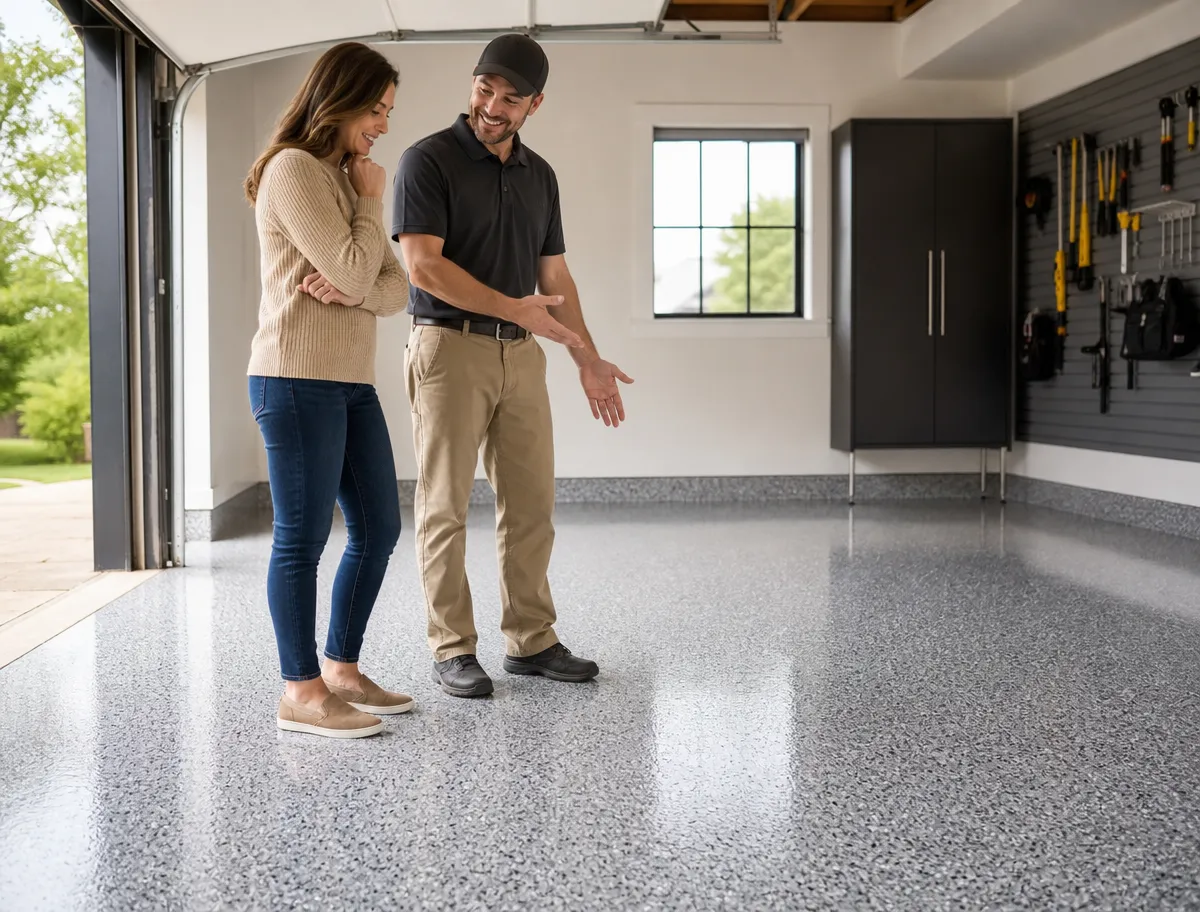
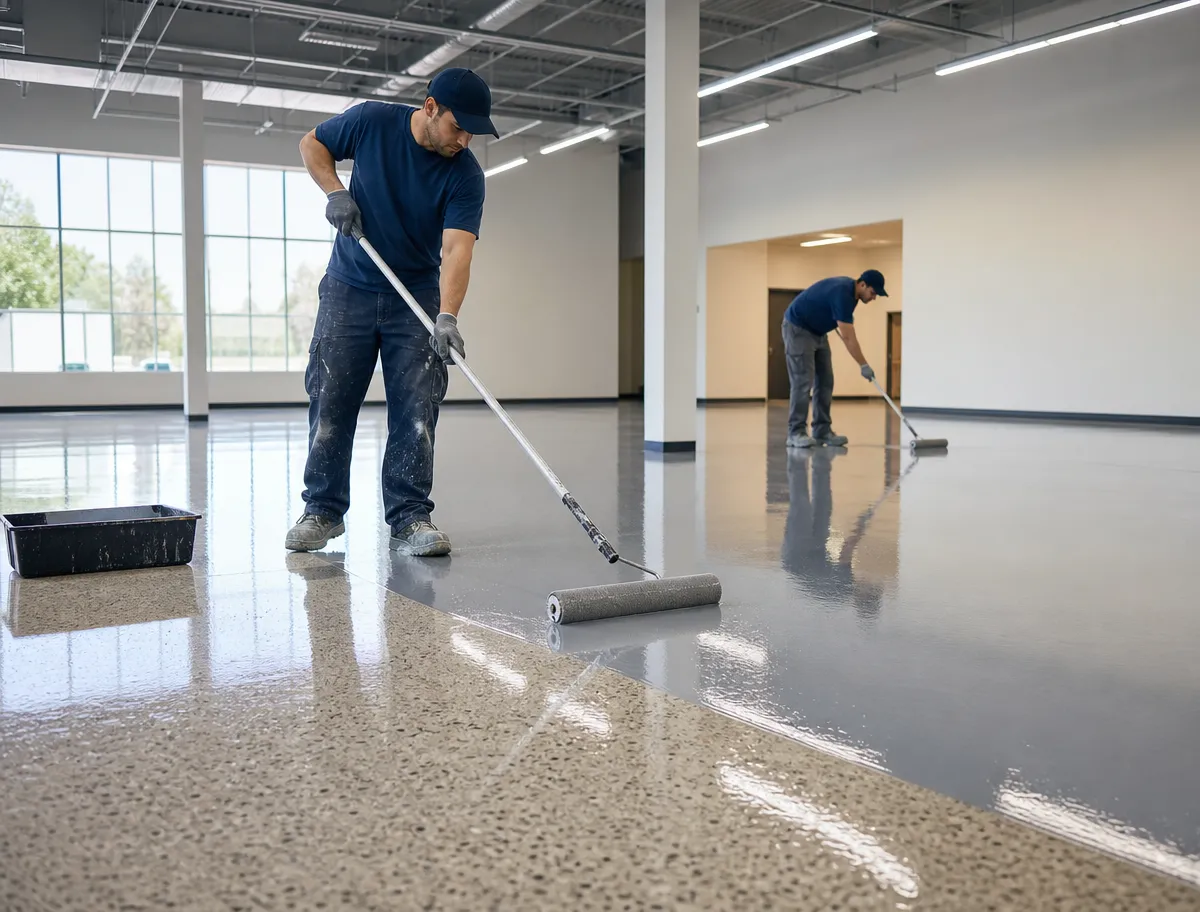
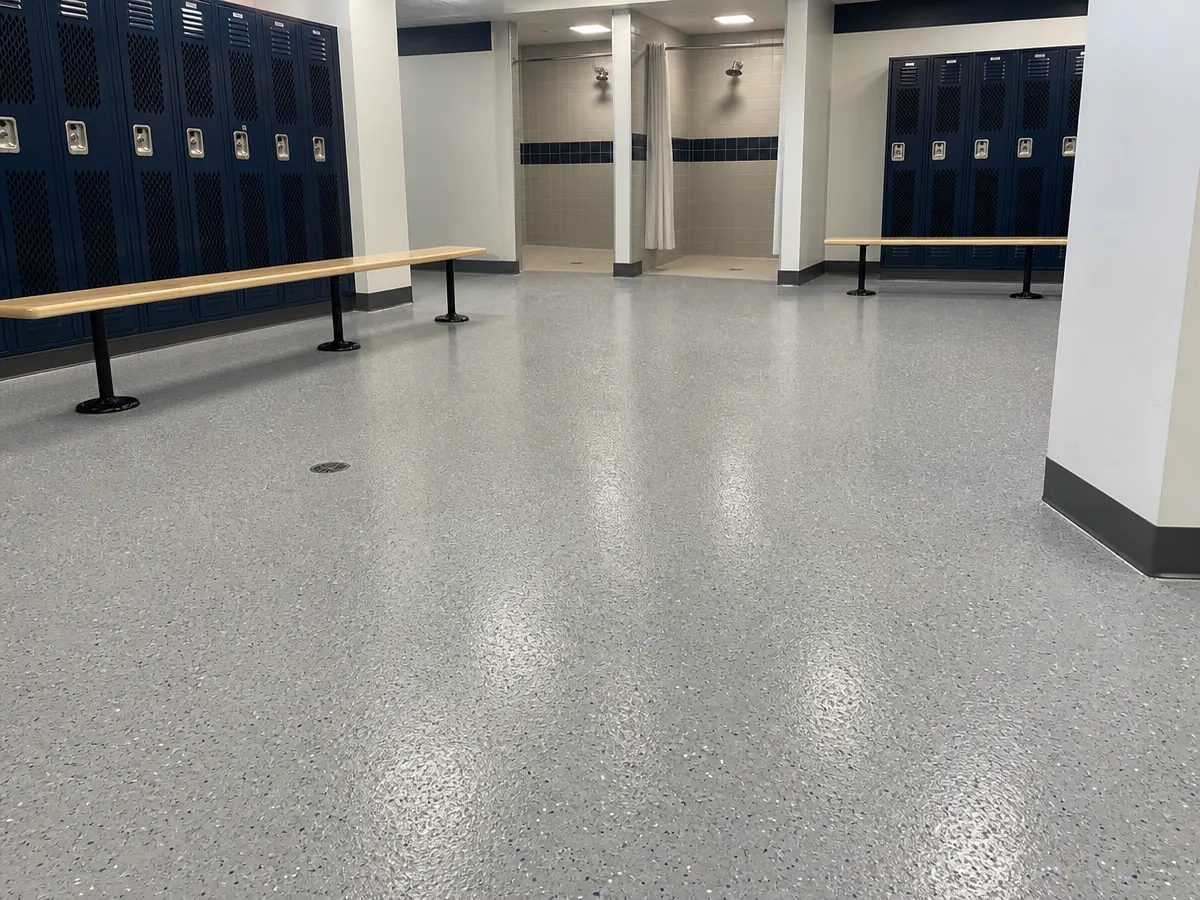
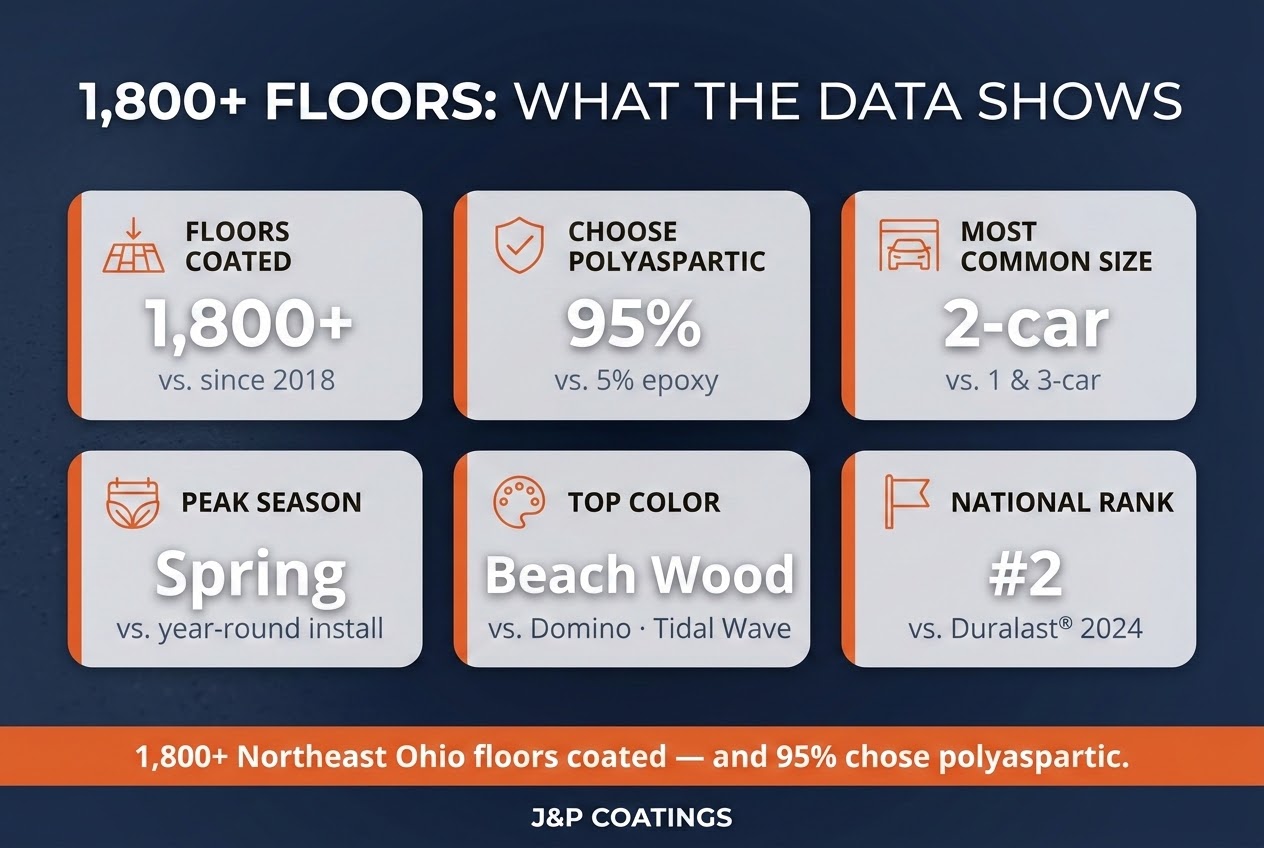
After installing more than 1,800 garage floor coatings across Greater Cleveland and Northeast Ohio since 2018, the clearest lesson is that a floor lasts or fails on surface prep — not on the coating you pick. The single most common problem we uncover once we start grinding is a previous coating installed over badly prepped concrete, and it’s the hardest thing to remove. Roughly 95% of our customers choose Duralast® Polyaspartic over epoxy, most are protecting a two-car garage, and most call in spring to fix or preserve a floor they already have.
What have we actually learned after 1,800+ garage floors?
When we poured our first Duralast® Polyaspartic garage floor in 2018, we assumed the questions homeowners cared about would be mostly about color and price. Eight years and more than 1,800 projects later, the real story is different — and it lives underneath the floor, in the concrete almost nobody thinks about.
J&P Coatings is a family-owned contractor based in Middlefield, Ohio, and we’ve coated garages, basements, and commercial floors across Cuyahoga, Lake, Geauga, and Erie (PA) counties. Because every project starts the same way — grinding the existing slab down to raw concrete — we’ve effectively run 1,800 field tests on how Northeast Ohio floors hold up. This is what that data shows, in plain terms, with no marketing gloss.
What’s the most common problem we find under Cleveland garage floors?
The answer surprises people. It isn’t oil staining or moisture — it’s a previous coating that’s already failing. More often than any other single issue, we start a job and find a layer of old epoxy or a big-box DIY kit that’s peeling, bubbling, or delaminating from the slab. And here’s the frustrating part: a failed coating is the hardest thing to remove. Grinding off a bonded-but-failing layer takes far more time and abrasive than prepping bare concrete ever would.
Why does that old coating fail in the first place? Almost always because the surface was never properly opened up before it went down. Concrete has to be mechanically profiled — ground open — so the coating can lock into the pores. Skip that step and you get a floor that looks great for a season and then lets go. Our Duralast® Polyaspartic system is only as good as the prep it sits on, which is why we diamond-grind every single floor, without exception.
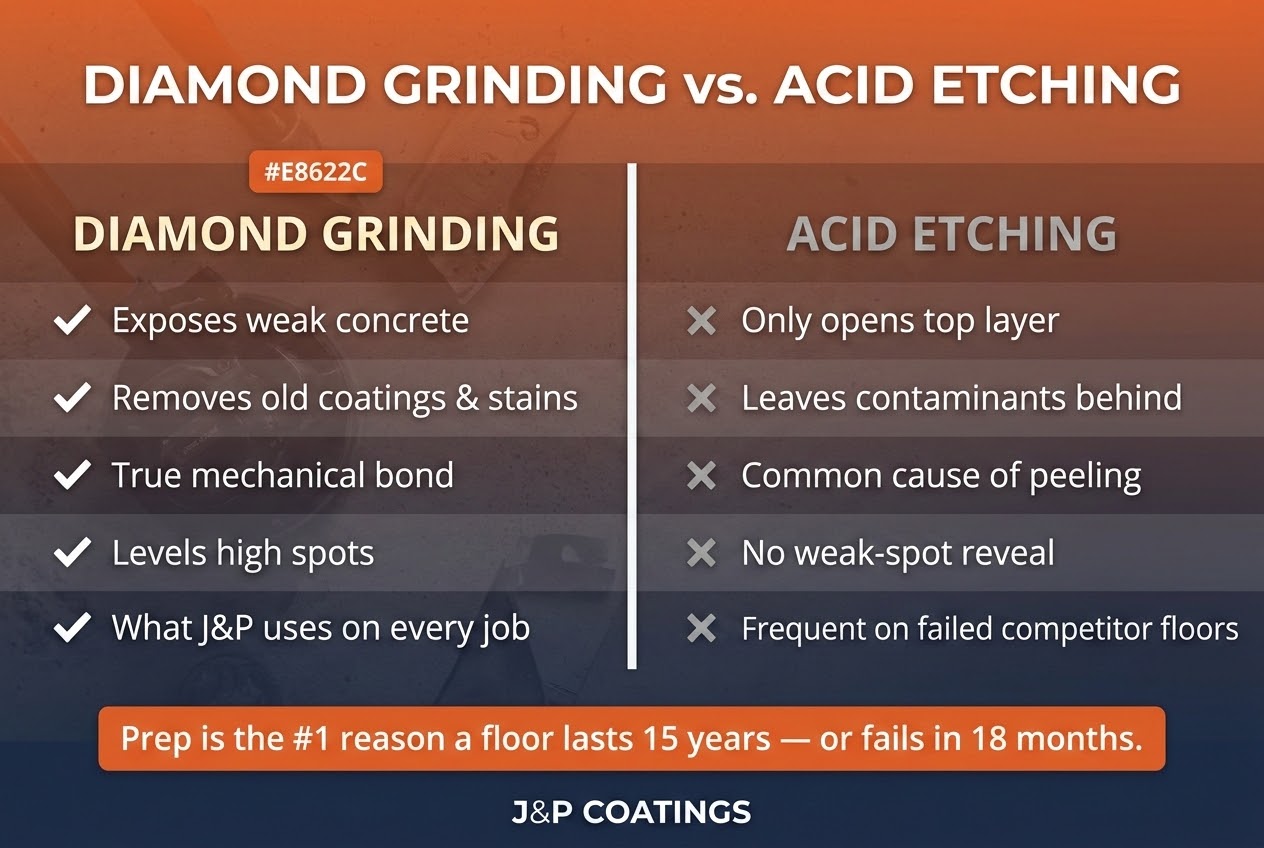
The industry shortcut we see most on failed floors is acid etching instead of diamond grinding. Etching washes acid over the surface to rough it up slightly, but it can’t remove old coatings, glues, or contaminants, and it can’t reveal weak or crumbling concrete the way a grinder does. It’s faster and cheaper for the installer, but it’s the number-one reason coatings peel and “hot tire pickup” ruins a floor within a year or two.
If a contractor quotes you a garage floor coating and mentions “acid etch” or “just a quick wash and prime,” ask what happens to the weak concrete under the surface. A grinder pulls it up as dust; an acid wash leaves it in place — right where your new coating has to bond.
What colors do Cleveland homeowners actually choose?
After 1,800+ projects, three color-chip blends come up again and again in Northeast Ohio homes. They’re not the loudest or the flashiest — they’re the ones that hide dirt, complement a typical garage interior, and still look sharp years later.
A warm, neutral tan-and-gray blend that reads clean in almost any garage and does an excellent job hiding everyday dust and tire marks.
A crisp black-and-white chip mix that leans modern and pairs well with dark cabinets, epoxy walls, and monochrome garages.
A cooler blue-gray blend for homeowners who want a bit more character without straying from a neutral, resale-friendly look.
Metallic and solid-color finishes are far less common in residential garages, but they’re the first pick for showrooms, automotive shops, and commercial kitchens where the floor is part of the brand. You can see the full palette on our chip-color page or browse recent finished floors in our gallery to see how each blend looks at full scale.
Polyaspartic vs. epoxy — what do 95% of our customers pick, and why?
When customers understand both options, the split is lopsided: about 95% choose Duralast® Polyaspartic over standard epoxy. That’s not us steering them — it’s what happens when people learn how the two systems actually behave in an Ohio garage. Nationally, cost guides put epoxy around $4–$10 per square foot and polyaspartic around $5–$12 per square foot installed, so the price gap is smaller than most people expect for a system that lasts far longer.
The reasons customers give for choosing polyaspartic are consistent:
- Same-day return to service — it cures fast enough that you can park on it that evening, instead of waiting days for epoxy.
- Year-round installation — Ohio winters don’t stall the project the way they do with temperature-sensitive epoxy.
- UV stability — it won’t yellow or fade near garage doors and windows the way epoxy can.
- Longevity — a properly installed polyaspartic floor is built to last 15+ years, versus roughly 5–10 for epoxy.
The homeowners who do choose epoxy coatings are usually working on an interior space — a basement or indoor commercial area — where UV exposure and freeze-thaw aren’t factors and budget is the priority. If you want the head-to-head details, our flooring options comparison breaks down each system side by side.
How much does a garage floor coating cost in Cleveland?
Pricing depends on square footage, the condition of your slab, and how much decorative detail you want — but based on the projects we’ve completed across Greater Cleveland, here are the ranges homeowners can realistically plan around.
| Project Type | Typical Cost Range | Notes |
|---|---|---|
| 1-car garage (Duralast® Polyaspartic) | $800–$1,500 | Cleanest, fastest projects |
| 2-car garage (Duralast® Polyaspartic) | $1,500–$3,000 | Our most common project |
| 3-car garage (Duralast® Polyaspartic) | $2,500–$4,500 | Larger footprint, same process |
| Basement floor | $1,500–$4,000 | Size-dependent |
| Commercial kitchen | $2,000–$8,000+ | Slip-resistant, high-durability |
| Automotive shop | $3,000–$15,000+ | Heavy-equipment rated |
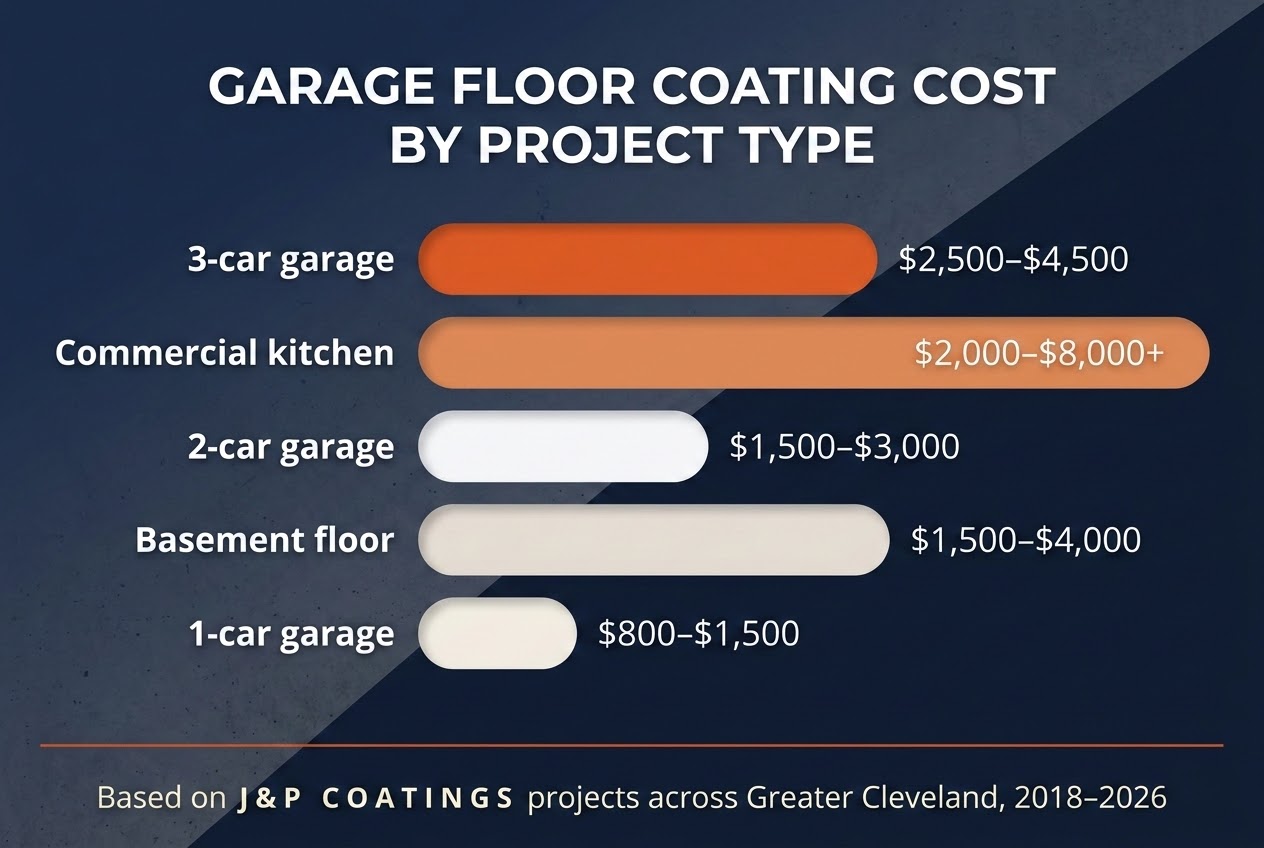
The two-car garage is by far our most common project, which is why that $1,500–$3,000 range is the number most Cleveland homeowners end up planning around. For comparison, regional aggregators like Angi list two-car epoxy work in a similar $1,100–$4,300 band, so our ranges track the market while including full diamond-grinding prep. The biggest cost swing is almost always slab condition — major cracking or a failed previous coating adds prep time. Seasonal offers can also take a chunk off the total.
Want a real number for your garage?
Every slab is different, and the only way to price it accurately is to see it. We’ll give you a free, no-pressure estimate with a clear scope — diamond grinding included, always.
📞 Call (440) 557-3141 Get a Free EstimateWhen do most Cleveland homeowners call — and can you coat a floor in an Ohio winter?
Our phone rings most in spring. Homeowners come out of winter, see the salt stains and chips the season left behind, and want the floor fixed before summer. It’s a predictable annual pattern after eight years of tracking it.
But here’s what surprises people: you don’t have to wait for spring. Because polyaspartic installs in a wide temperature range, we complete projects in January and February regularly. If anything, booking in the off-season often means faster scheduling. Coating in late winter also means your floor is fully cured and ready before the next round of road salt arrives.
That salt is the real enemy of Northeast Ohio concrete. Deicing salt lowers the freezing point of water, which drives more freeze-thaw cycles into your slab — and research on de-icing salt-frost scaling shows how quickly that combination pits and flakes an unprotected surface. A UV-stable, salt-resistant coating is the single best defense a Cleveland-area garage floor can have.
Do commercial and residential customers want different things?
Less than you’d think. Whether it’s a homeowner or a business, the core motivation is the same: fix and preserve a floor they already have. That’s the number-one reason people call us — not a full makeover, and not prepping to sell the house, but protecting and restoring existing concrete before it gets worse.
The one consistent difference is durability questions. Commercial customers almost always ask the same thing: will this stand up to heavy equipment? Forklifts, jacks, rolling toolboxes, dropped parts. The answer is what makes polyaspartic a good fit for shops and warehouses, and it’s why our commercial floor coatings use the same grind-first process as a residential garage — just specified for the load.
How do you choose a garage floor coating contractor in Northeast Ohio?
After eight years in this market, the difference between a floor that lasts 15 years and one that fails in 18 months usually comes down to a handful of questions. Ask any contractor these before you sign:
- Do you use diamond grinding or acid etching for surface prep?
- What coating brand are you using, and what are the manufacturer’s specs?
- Is the warranty transferable if I sell the house?
- Can you show references from projects in the last 12 months?
- Are you a certified installer for the system you’re quoting?
💎 Worth investing in
- Full diamond-grinding prep
- A UV-stable polyaspartic top coat
- Proper crack repair before coating
- A transferable warranty
- A certified, reviewed installer
💰 Where you can save
- Skip premium metallics for a daily-use garage
- Book in the off-season for scheduling flexibility
- Stack a current seasonal offer
- Coat a clean, sound slab (less prep time)
- Choose a resale-friendly neutral chip blend
For J&P specifically, the answers are simple: diamond grinding on every job, Duralast® Polyaspartic rated 5× stronger than epoxy, a limited transferable warranty, 120+ verified 5-star reviews, and recognition as the #2 national Duralast® installer in 2024.
◆ TL;DR — Garage floor coatings in Northeast Ohio
- Prep is everything: the most common problem we find is a previous coating installed over unprepped concrete — always diamond-grind.
- Polyaspartic wins: ~95% of our customers choose it over epoxy for same-day cure, year-round install, and 15+ year life.
- Most common project: a two-car garage, typically $1,500–$3,000.
- Popular colors: Beach Wood, Domino, and Tidal Wave.
- Best time to call: spring is busiest, but winter installs are easy and often faster to schedule.
- Next step: call (440) 557-3141 for a free estimate.
Frequently Asked Questions
Is polyaspartic worth the extra cost over epoxy?
For a garage in Northeast Ohio, yes. Polyaspartic installs same-day, cures fast enough to park on that evening, resists UV yellowing and road salt, and is built to last 15+ years versus roughly 5–10 for epoxy. The price difference is modest, and about 95% of our customers choose it once they understand both systems.
Why do garage floor coatings peel, and how do you prevent it?
Peeling almost always traces back to surface preparation. If the concrete isn’t mechanically ground open, the coating can’t bond, and it lets go — often within a year or two. We diamond-grind every floor to raw concrete and repair cracks before any coating goes down, which is the single biggest factor in a floor that lasts.
Is acid etching good enough, or do I need diamond grinding?
Acid etching only opens the very top layer and can’t remove old coatings, glues, or weak concrete. Diamond grinding mechanically profiles the slab and pulls up crumbling material as dust, creating a true bond. It’s the reason we never acid etch — grinding is what makes a coating last.
Can you coat a garage floor during an Ohio winter?
Yes. Our Duralast® Polyaspartic system installs across a wide temperature range, so we complete projects in January and February regularly. Off-season booking often means faster scheduling, and a winter install means your floor is cured and salt-ready before the next season.
How long does a professional garage floor coating actually last?
A properly prepped and installed polyaspartic floor is built to last 15+ years. The lifespan is driven far more by surface preparation than by the coating brand — a premium coating over bad prep will still fail, while a quality system over a diamond-ground slab holds up for the long haul.
What’s the most popular garage floor color in Cleveland?
Across 1,800+ projects, Beach Wood is our most-requested chip blend, followed by Domino and Tidal Wave. These neutral, dirt-hiding blends stay resale-friendly and look sharp for years. Bolder metallic finishes are more common in showrooms and shops than in home garages.
Will a coating hold up to heavy equipment in a commercial space?
Yes — it’s the question commercial customers ask most. Specified correctly, polyaspartic handles forklifts, jacks, rolling toolboxes, and dropped parts. We use the same grind-first process for commercial floors as we do for garages, just engineered for the load the space will see.
How much does it cost to coat a two-car garage in Cleveland?
Most two-car garages fall in the $1,500–$3,000 range with a full Duralast® Polyaspartic system and diamond-grinding prep. The biggest cost variable is slab condition — heavy cracking or a failed previous coating adds prep time. A free on-site estimate is the only way to get an exact number.
Fix it once. Protect it for 15 years.
Family-owned since 2018 • Diamond grinding on every job • #2 national Duralast® installer 2024 • Limited transferable warranty • Free estimates across Greater Cleveland, NE Ohio & NW Pennsylvania.
📞 Call (440) 557-3141 Request a Free Estimate★ Current offers: $200 off 2-car • $300 off 3-car • $500 off basement projects ★