Quick Answer: Not all automotive floor coatings are the same — and the differences matter in Cleveland’s climate. A service bay needs maximum chemical resistance, slip-resistant chip density, and flexibility through Northeast Ohio’s 40+ freeze-thaw cycles per winter. A dealership showroom needs high-gloss aesthetics, easy tire mark cleanup, and a surface that makes the brand look premium. A collector’s garage needs all of the above. J&P Coatings installs the Duralast® Polyaspartic system for all three audiences across Greater Cleveland, Cuyahoga County, and Northeast Ohio — with diamond grinding prep, same-day installation, and a transferable warranty.
Cleveland’s automotive sector is substantial. The Greater Cleveland market includes independent service centers and specialty shops throughout Cuyahoga, Geauga, and Lake Counties, major dealership groups along the Euclid Avenue and auto mall corridors, and a significant base of serious car collectors — from Shaker Heights to Chagrin Falls to the western suburbs — who invest in their garage spaces the way they invest in their vehicles.
These three groups share one thing: they all need a floor that can handle a car. But beyond that, their requirements diverge sharply. The service bay floor that works well for a transmission shop in Lakewood has different specifications than the showroom floor a Genesis or Porsche dealer needs on Mayfield Road. And neither of those is quite right for a collector’s showcase garage in Westlake or Strongsville where the floor’s appearance matters as much as its performance.
J&P Coatings is a family-owned floor coating contractor based in Middlefield, Ohio, serving Cleveland, Northeast Ohio, and Western Pennsylvania since 2020. Dave Borkholder, co-founder and #2 national Duralast® installer in 2024, has installed automotive floor systems in every segment of this market. This guide covers what each segment actually needs — and why the system spec that’s right for one may not be right for the others.
Why Does the Right Automotive Floor Coating Spec Differ by Facility Type?
The fundamental difference is in the performance priorities. Every automotive floor sees vehicles, petroleum chemicals, and foot traffic — but the relative intensity of each, and the importance of aesthetics, varies dramatically:
| Performance Priority | Service Bay | Dealership Showroom | Collector Garage |
|---|---|---|---|
| Chemical resistance | Critical — constant exposure | Moderate — occasional drip | High — working garage |
| Slip resistance | Critical — wet from washing | Low — dry, customer-facing | Moderate — personal use |
| Aesthetics | Secondary — clean and professional | Primary — brand presentation | Primary — showcase quality |
| Impact/abrasion resistance | Critical — tools, jacks, equipment | Moderate — foot traffic | High — working on cars |
| UV stability | High — overhead doors open | Critical — large window exposure | Moderate — standard garage |
| Installation downtime tolerance | Very low — revenue loss per bay | Low — operational disruption | Flexible — personal space |
What Is the Right Floor Coating System for a Cleveland Automotive Service Bay?
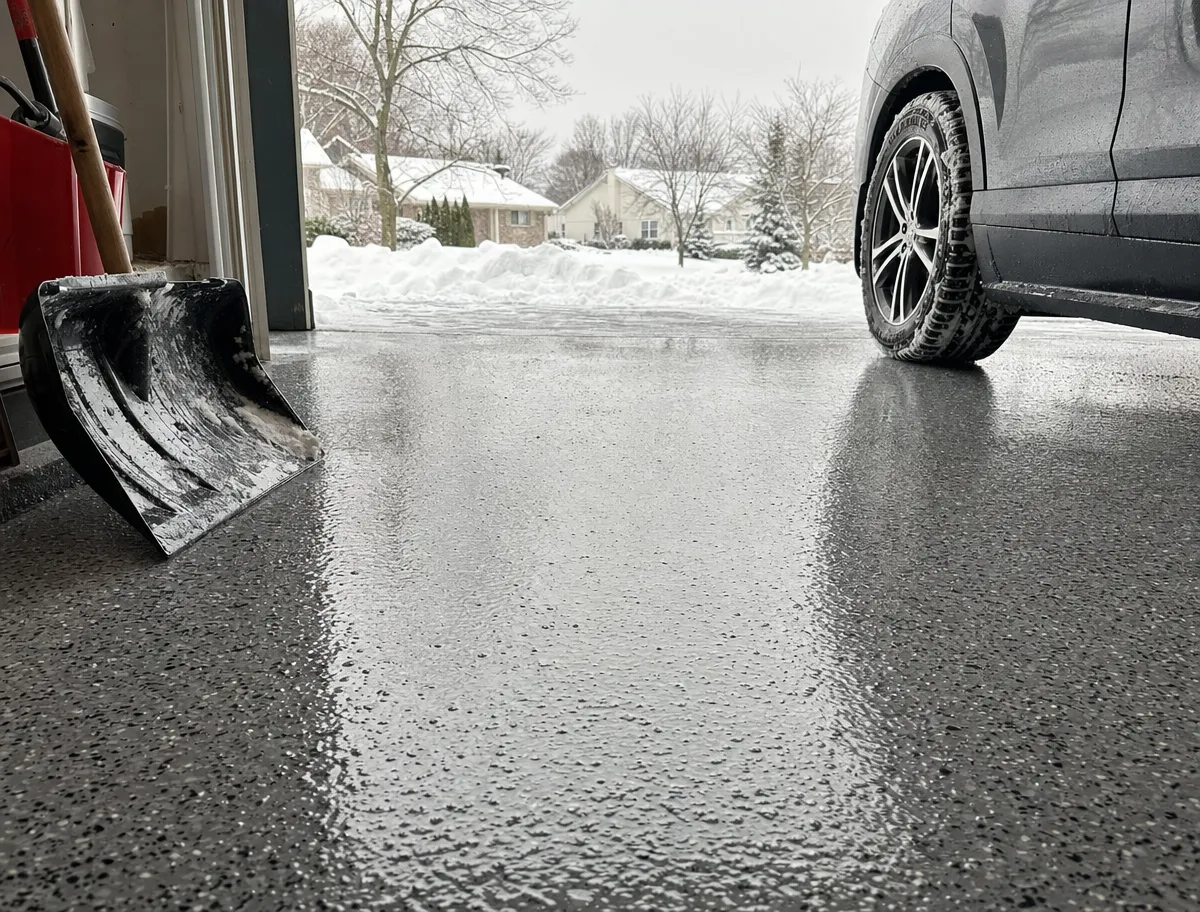
Service bays are the hardest environment in the automotive sector for floor coatings. Cleveland and Northeast Ohio service facilities produce everything a floor coating can encounter: motor oil, transmission fluid, brake fluid, power steering fluid, battery acid, antifreeze, road salt, vehicle wash runoff, dropped wrenches and sockets, floor jacks dragged across the surface, and lift pads pressed against the concrete repeatedly. Ohio’s climate adds 40+ freeze-thaw cycles per winter that stress any rigid coating bonded to the slab below.
What the service bay system must do
A Cleveland automotive service bay floor coating needs to:
- Resist petroleum chemical penetration without surface degradation — oil that sits on the floor should wipe off, not soak in and leave permanent staining or soften the coating
- Handle hot tire contact without delaminating — vehicles on lifts produce warm tires that cause standard epoxy to soften and peel off when the car moves
- Provide appropriate slip resistance — service bays are wet from vehicle washing, fluid spills, and weather tracked in from outside; OSHA standards for walking-working surfaces require slip resistance in areas with wet or oily surfaces
- Flex with the concrete through freeze-thaw cycles — a rigid epoxy on a Cleveland concrete slab accumulates stress at control joints through each winter cycle; professional polyaspartic systems are formulated to accommodate that movement
- Return to service quickly — downtime in a revenue-generating service bay is a real business cost; J&P Coatings’ Duralast® system cures same-day with vehicle traffic within 24 hours
J&P Coatings’s service bay specification
The Duralast® Polyaspartic system J&P installs in Cleveland automotive service bays:
- Diamond grinding to CSP-2 or CSP-3: Professional diamond grinding prepares the concrete pore profile and removes oil-contaminated surface concrete. In active service bays with years of vehicle service, oil saturation in the top concrete layer makes proper surface prep — not just cleaning — the non-negotiable first step.
- Polyurea base coat: High-adhesion, flexible aromatic polyurea base provides the structural adhesion layer and moisture vapor resistance.
- Full-broadcast vinyl chip: Dense chip broadcast at service bay density provides texture, slip resistance, and a practical surface that hides minor wear and scuffs between cleanings.
- Aliphatic polyaspartic topcoat: UV-stable, chemically resistant topcoat that stays non-yellow even in bays with overhead door exposure to sunlight. Oil spills wipe completely clean. The surface is bright enough to improve bay lighting efficiency — important in Cleveland’s gray winter months when natural light is limited.
Cleveland-specific detail: Northeast Ohio’s road salt season runs November through March. Cleveland service bays see daily road salt tracked in on every vehicle that comes through for service during that period. Standard epoxy’s binder degrades under prolonged salt exposure — the aliphatic polyaspartic topcoat is chemically resistant to the chloride compounds in road salt and does not degrade with repeated contact.
What Is the Right Floor Coating for a Cleveland Dealership Showroom?
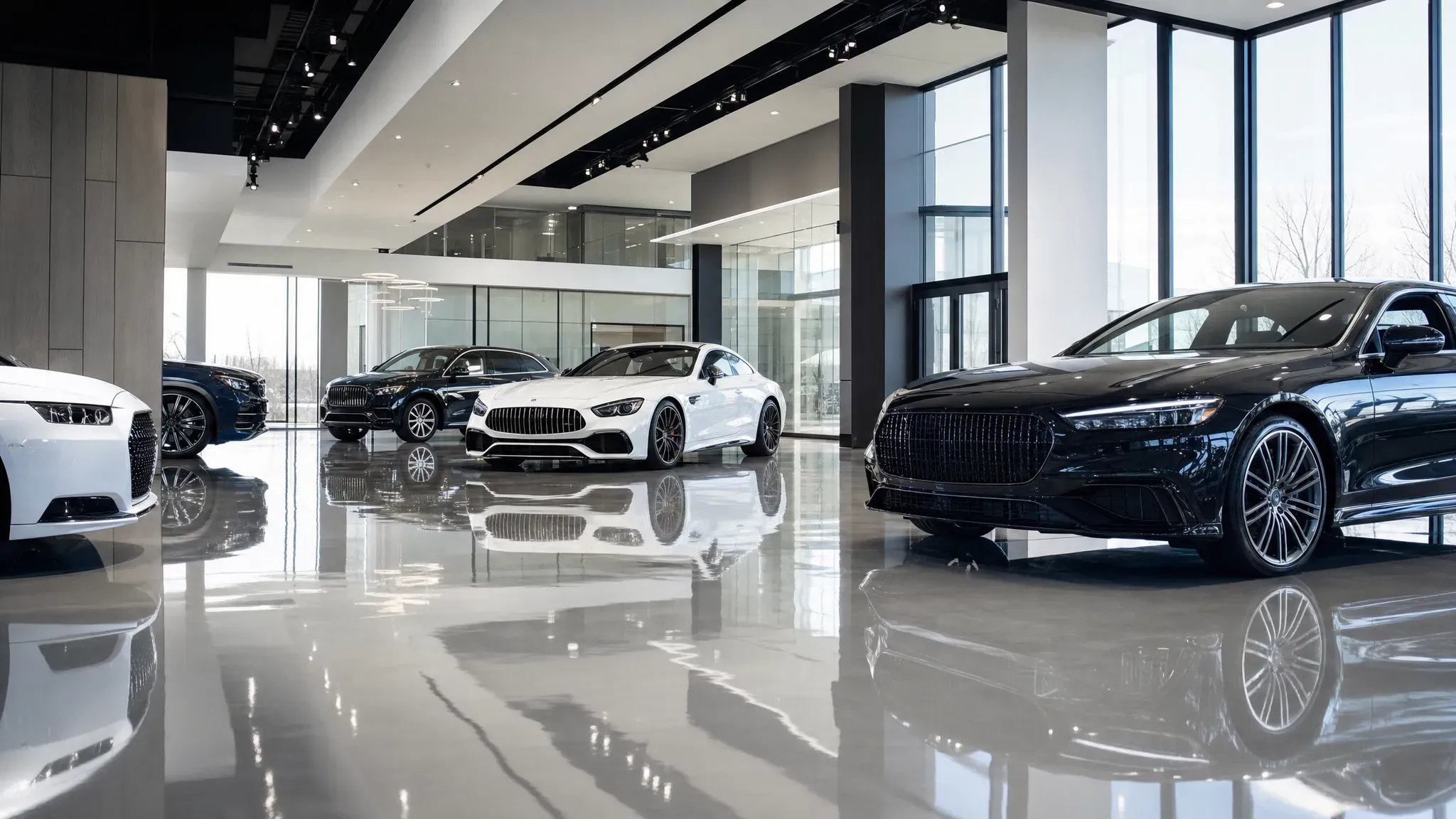
The dealership showroom floor has a fundamentally different job than the service bay — it has to make the brand look premium while holding up to real-world use. Cleveland and Northeast Ohio’s dealership corridor, from the Euclid Avenue strip to the major auto malls in Mayfield Heights, Strongsville, and North Olmsted, includes luxury brands where the showroom presentation is part of the sales experience.
What the dealership showroom system must do
A Cleveland dealership showroom floor coating needs to:
- Provide a high-gloss, professional finish — the floor reflects lighting across the showroom and creates the visual context for the vehicles on display; a dull or worn-looking floor undermines the brand presentation regardless of the cars’ condition
- Resist tire marks — new vehicles with soft tires driven slowly across a showroom floor leave faint tire marks that accumulate over time; a properly specified topcoat minimizes adhesion between warm rubber and the floor surface
- Handle UV exposure without yellowing — showrooms have large windows, skylights, and glass facades; an epoxy or aromatic polyurea floor in a window-exposed showroom will yellow visibly within 1 to 3 years; aliphatic polyaspartic is UV-stable and does not yellow
- Clean easily with commercial cleaning equipment — daily cleaning of a dealership showroom floor needs to be fast and thorough; the non-porous polyaspartic surface does not trap dirt or require specialized cleaning products
- Be installed without multi-day closure — most Cleveland dealerships cannot close the showroom for 3 days; J&P’s same-day Duralast® installation means the showroom is closed for one day at most, often just overnight
Showroom finish options J&P installs in Cleveland
For dealership showrooms, J&P Coatings offers several finish specifications depending on the brand identity and floor area:
- High-gloss solid polyaspartic: A clean, single-color high-gloss finish — available in white, light gray, charcoal, black, and custom colors — creates the classic showroom look that reads as premium in any automotive brand context. The solid color floor provides a neutral backdrop for the vehicles.
- Decorative chip broadcast at showroom density: A lighter chip broadcast (vs. the heavier density in service bays) creates a stone-look or terrazzo appearance with subtle texture. This finish has become common in volume dealerships where the floor needs to look professional while hiding the scuffs and marks of daily foot traffic more effectively than a solid color.
- Metallic epoxy or polyaspartic pour: For luxury and performance brand showrooms where visual impact is part of the brand experience — Porsche, Maserati, Ferrari, custom car dealerships — a metallic epoxy or metallic polyaspartic pour creates a one-of-a-kind, three-dimensional floor that is genuinely distinctive. These systems are as durable as standard chip systems and are just as easy to maintain.
Brand alignment matters: A Honda or Toyota dealership and a Lamborghini dealership have completely different floor expectations — different colors, different gloss levels, different finish complexity. J&P Coatings evaluates each showroom space, reviews the brand visual guidelines, and recommends a finish specification that enhances the dealership’s identity rather than creating a generic floor that could belong to any commercial space.
What Is the Right Floor Coating for a Car Collector’s Garage in Northeast Ohio?
Car collectors represent a segment of the Cleveland and Northeast Ohio market that is larger than most people realize. The region’s affluent suburbs — Shaker Heights, Pepper Pike, Chagrin Falls, Westlake, Avon, Bratenahl, Hudson — house a significant number of serious collectors who invest in multi-car garages that are purpose-built or retrofitted for vehicle storage and display.
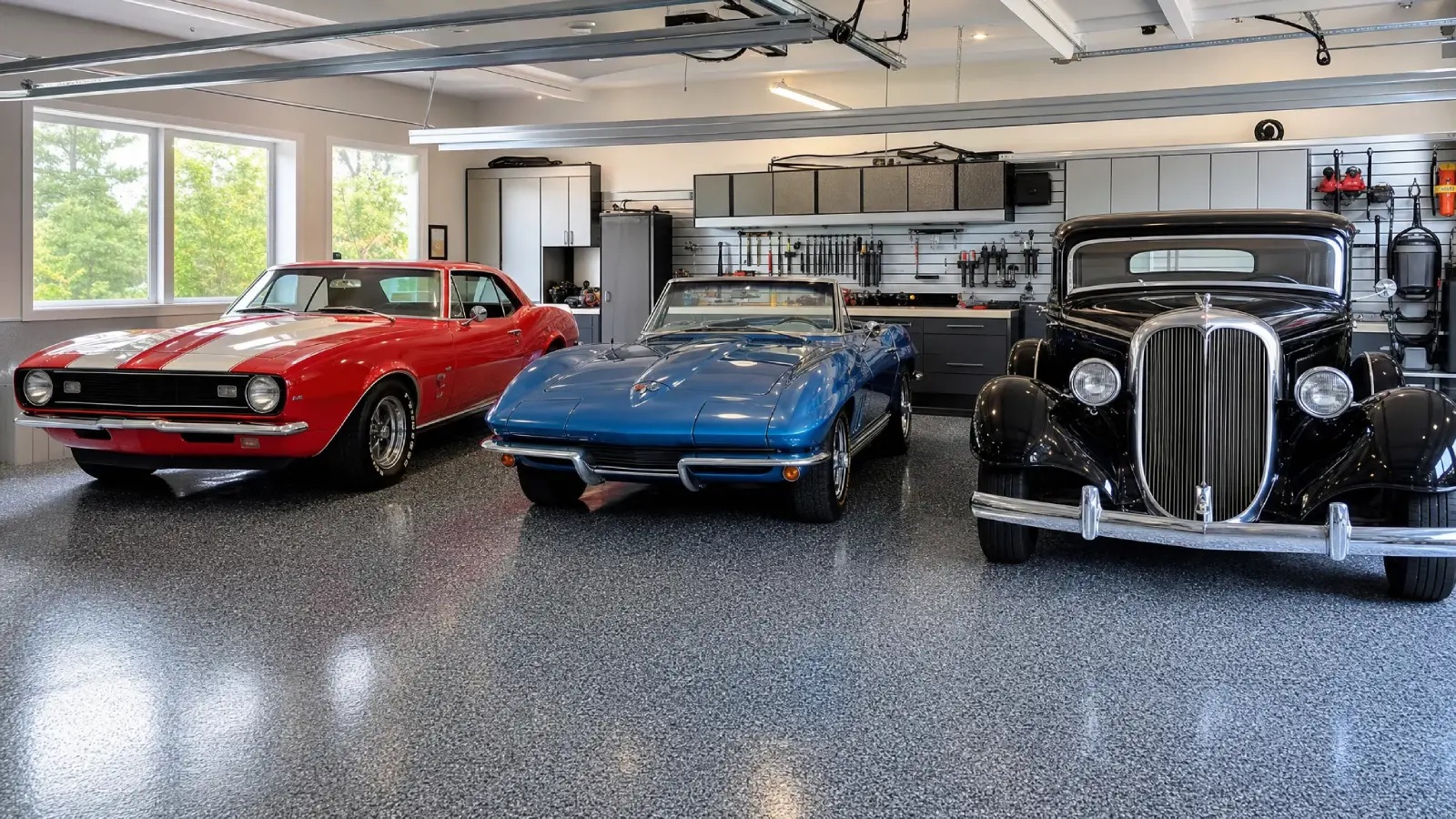
The collector’s garage has a unique requirement: it must simultaneously perform like a service bay (the car comes down off jacks, fluids drip, tools get dropped) and look like a showroom (the space is part of how the collection is presented — to friends, fellow enthusiasts, at club events, and in photos). This is not a contradiction — the Duralast® Polyaspartic system handles both demands — but the finish specification is different from what a purely functional service bay or a purely aesthetic showroom would receive.
What the collector garage system must do
- Display-quality finish: The floor should complement the vehicles stored on it. High-gloss systems in light neutral colors — white, silver, light gray — reflect light upward and make garage photography dramatically more flattering. Darker collector garages with specific color identities (Corvette red, Porsche silver, Ford blue) benefit from color-coordinated finishes.
- Resist actual use: Collectors actually work on their cars. Fluids drip. Brake cleaner gets used. Floor jacks go out and come back. The floor coating in a collector’s garage needs to handle all of this without softening, staining, or requiring special treatment after a service session.
- Maintain appearance with minimal maintenance: Collectors want to hose the floor down and have it look pristine. The non-porous polyaspartic surface makes this possible — no scrubbing required for oil or fluid spills if addressed promptly.
- Protect the concrete for property value: Greater Cleveland’s residential real estate market increasingly values finished garage spaces. A properly coated collector garage floor adds measurable value to a property and is part of the investment in the garage infrastructure.
Finish options popular with Cleveland-area collectors
- Full-broadcast chip in light neutral colors: Classic, practical, durable. The chip surface adds texture and hides minor imperfections from real use while providing a premium appearance. Lighter chip blends (white, silver, quartz) maximize light reflection in the garage.
- Solid high-gloss in custom colors: Some collectors specify a floor color to complement their primary vehicle — Porsche GT Silver, Ferrari Rosso Corsa, classic black-and-white checkerboard patterns for vintage American collections.
- Metallic epoxy pour: The most visually dramatic option — metallic pigments in a clear polyaspartic base create a deep, three-dimensional floor with ocean, marble, lava, or custom effects. Every metallic floor is unique. For collectors whose garages are gallery spaces as much as storage spaces, metallic systems create a floor that is genuinely art.
What Does the Installation Process Look Like for Cleveland Automotive Facilities?
J&P Coatings works around automotive business schedules. The Duralast® system installation process:
- Free on-site estimate: J&P evaluates the concrete, identifies oil contamination depth, existing cracks or spalling, moisture conditions, and previous coating failures. For commercial service bays, we evaluate the lift locations and high-traffic zones to specify the appropriate system and chip density. Estimate is provided on-site, same day.
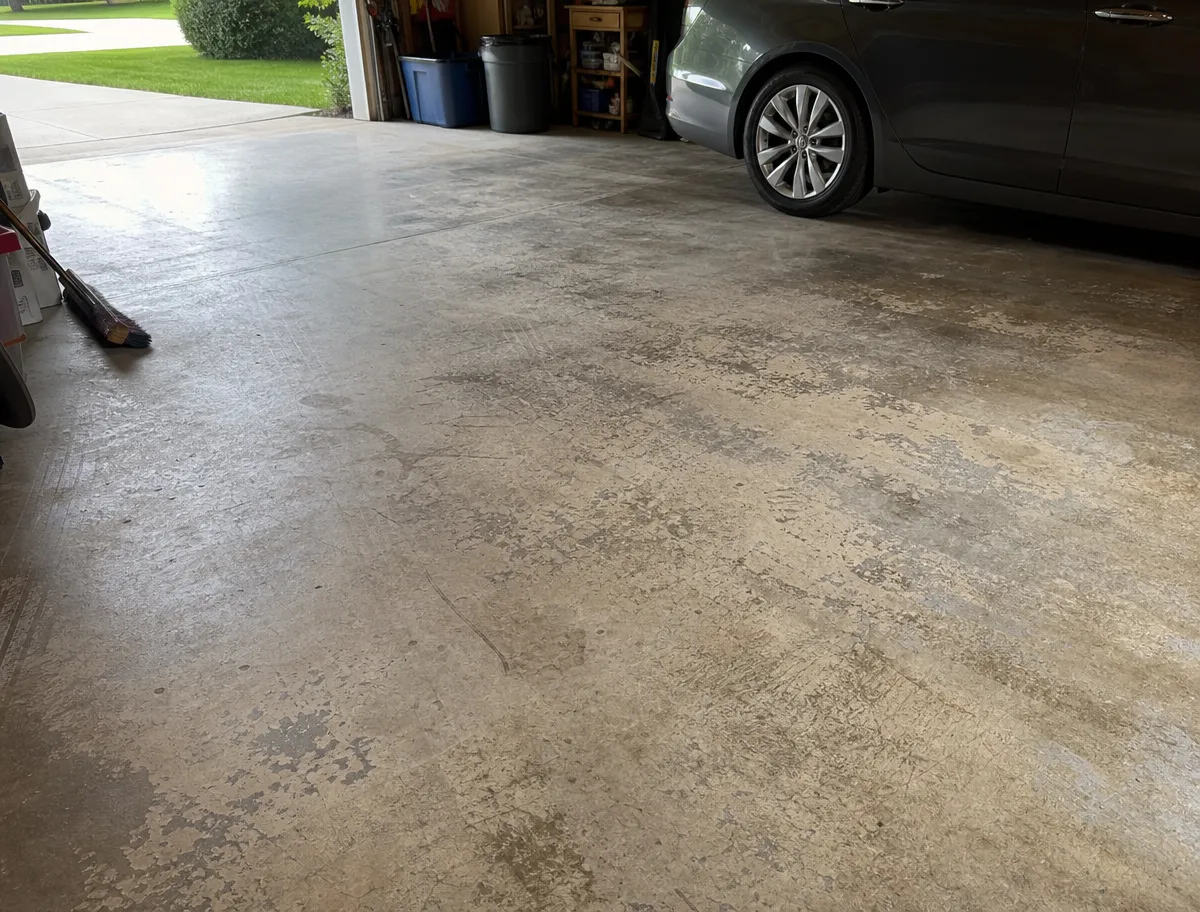
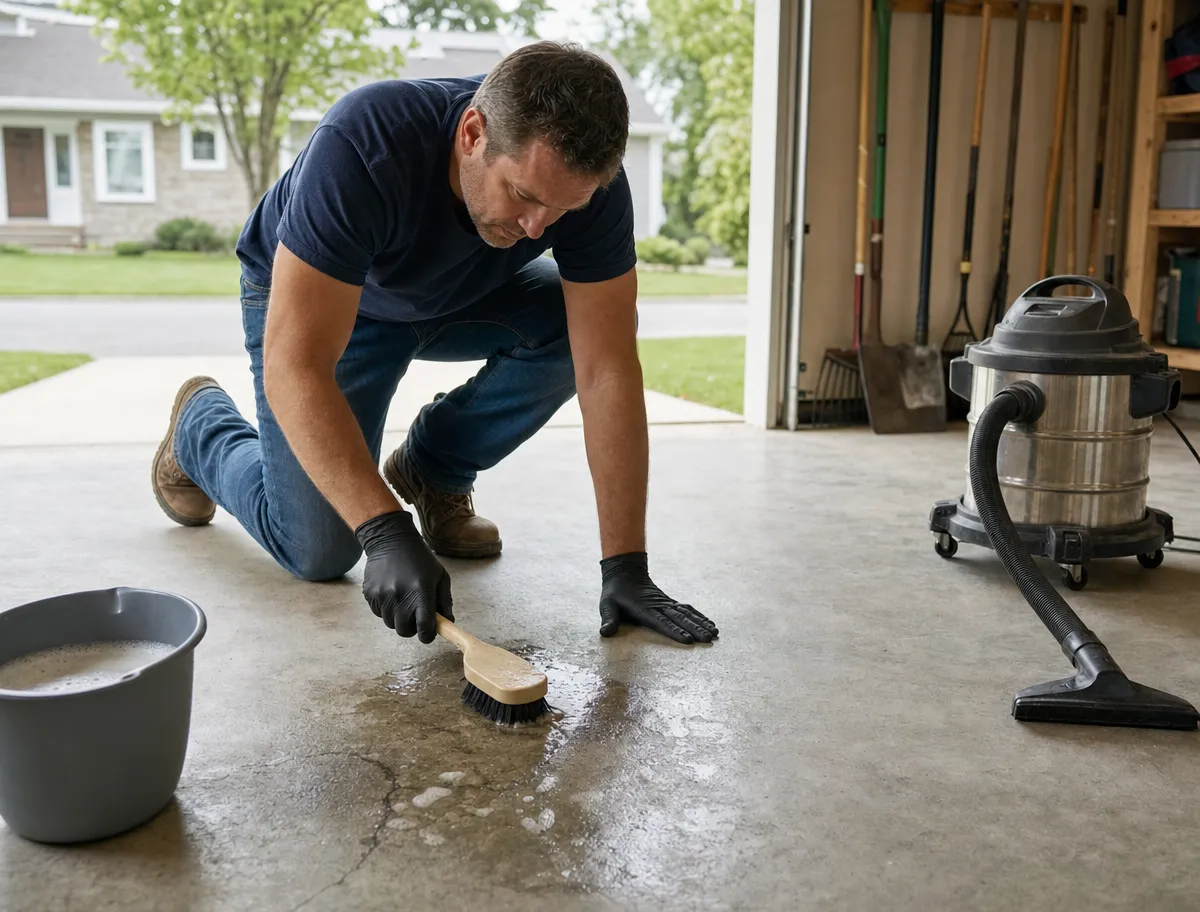
- Diamond grinding: Professional diamond grinding removes oil-contaminated surface concrete, opens the concrete pore profile to CSP-2 or CSP-3, and prepares the substrate for maximum adhesion. This step is non-negotiable — it’s the difference between a coating that bonds and lasts versus one that begins failing within a season.
- Crack and spall repair: All cracks are filled with flexible polyurea crack filler. Spalled or pitted areas are leveled. Repairs are done before coating, not covered over by it.
- Polyurea base coat: The fast-curing polyurea base coat is applied immediately after prep. It penetrates the ground concrete profile and cures within minutes.
- Chip broadcast: Decorative vinyl chips are broadcast at the specified density for the facility type — heavy for service bays, lighter or omitted for showroom solid-color systems. Custom chip blends for collectors are pre-specified before the project day.
- Polyaspartic topcoat: The UV-stable aliphatic polyaspartic topcoat is applied, encapsulating the chips and creating the final surface. The floor is ready for light foot traffic the same day and vehicle traffic within 24 hours.
- Quality inspection: J&P inspects the completed floor before returning the space to use. All edge transitions, drain surrounds, and lift pad areas are verified to a professional finish.
For multi-bay facilities, J&P phases the project bay-by-bay so the facility remains partially operational throughout the project. Overnight and weekend scheduling is available for Cleveland dealerships and larger commercial automotive facilities.
How Much Does Automotive Floor Coating Cost in Cleveland, OH?
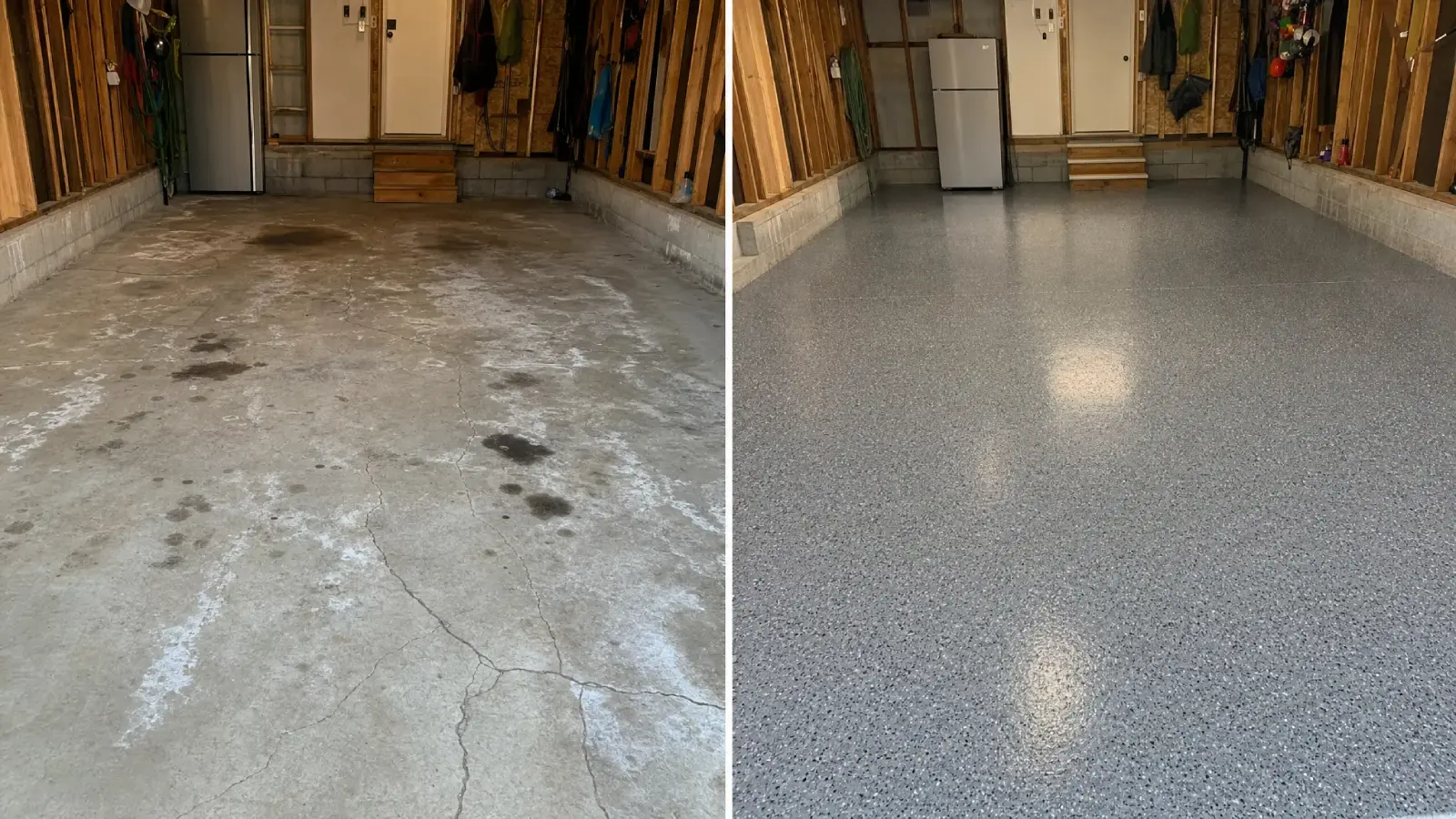
Automotive floor coating cost in Greater Cleveland depends on facility type, square footage, concrete condition, and system specification. J&P Coatings provides free on-site estimates with same-day written quotes — phone ballparks aren’t accurate because concrete condition and prep requirements vary too much between facilities.
General budgeting benchmarks for Cleveland area automotive projects:
- Service bays: $5–$10 per square foot installed for full Duralast® system with service bay chip density. A 1,000 sq ft two-bay shop runs approximately $5,000–$10,000. Significant oil contamination requiring additional grinding passes adds prep cost.
- Dealership showrooms: $5–$10 per square foot for standard chip or solid-color polyaspartic. Custom metallic or decorative systems run $8–$14 per square foot depending on the complexity of the pour. Large-format dealership floors are quoted on a per-project basis.
- Collector garages: $4–$9 per square foot for standard chip or solid-color systems. $9–$15+ per square foot for premium metallic epoxy or decorative pours. A three-car collector garage of approximately 900 sq ft typically runs $3,600–$8,100 for a standard system.
J&P’s value position: J&P Coatings installs the Duralast® Polyaspartic system — the same product line and installation process used in Duration Concrete Coatings installations in Fort Wayne — backed by a limited transferable warranty. Dave Borkholder, J&P’s co-founder, ranked #2 nationally among Duralast® installers in 2024. That ranking is based on installation volume, quality audits, and customer satisfaction ratings — not marketing.
Where Should Cleveland Automotive Facility Owners Invest vs. Save on Floor Coating?
Always invest here — never cut corners
- Diamond grinding prep: This is the most critical factor in coating longevity for every automotive floor type. Oil-contaminated service bay concrete, showroom slabs with previous coating failures, and collector garage floors with decades of vehicle parking all require diamond grinding before any coating. Saving on prep by accepting acid etching or surface cleaning costs significantly more when the coating fails in two winters.
- UV-stable aliphatic polyaspartic topcoat: Any automotive floor with natural light exposure — showrooms with windows, bays with overhead doors open during the day, collector garages with windows — requires an aliphatic polyaspartic topcoat. Aromatic polyurea topcoats yellow visibly within 2 to 3 years in UV-exposed environments. The chemistry difference is worth the premium.
- Appropriate slip resistance for service bays: OSHA walking-working surface standards require slip resistance in areas subject to wet or oily conditions. Service bay chip density is specified with this in mind. Reducing chip density to improve aesthetics in a working service bay creates a safety and compliance risk.
Where you have flexibility
- Chip color and blend: Every standard chip color combination performs identically. The premium is in custom or low-production blends, not in performance.
- Metallic finish complexity: A single-pour metallic system performs the same as a multi-color complex pour — the additional cost in premium metallic systems is entirely aesthetic. Choose based on your space and budget, not on the assumption that more complexity equals more durability.
TL;DR — Automotive Floor Coating Cleveland OH
- Service bays: Full-broadcast polyurea/polyaspartic system with service bay chip density, diamond grinding prep for oil contamination removal, UV-stable topcoat. Prioritizes chemical resistance, slip resistance, hot tire resistance, and same-day return to service.
- Dealership showrooms: High-gloss polyaspartic, decorative chip, or metallic system. Prioritizes UV stability (no yellowing), brand-appropriate finish, tire mark resistance, and easy daily cleaning.
- Collector garages: Display-quality finish with working-garage performance — full-broadcast chip, premium solid-color, or metallic pour. Reflects light, handles real use, maintains easily.
- All three share the same non-negotiables: diamond grinding prep, polyurea base coat, aliphatic polyaspartic topcoat, same-day installation.
- Cost: $4–$10/sqft for standard systems; $8–$15/sqft for premium metallic/decorative. Free on-site estimates with same-day quotes from J&P Coatings.
- Contact J&P Coatings for a free Cleveland area automotive floor coating estimate.
Frequently Asked Questions
What is the best floor coating for an automotive service bay in Cleveland?
A polyurea base coat with an aliphatic polyaspartic topcoat, installed over diamond-ground concrete, is the best system for Cleveland automotive service bays. Polyurea provides maximum adhesion, chemical resistance, and flexibility through Northeast Ohio’s freeze-thaw cycles. The polyaspartic topcoat adds UV stability, abrasion resistance, and chemical resistance to motor oil, brake fluid, transmission fluid, and road salt. Service bay chip density is specified for appropriate slip resistance under wet conditions. J&P Coatings completes most service bay installations in one day with 24-hour vehicle traffic return.
What floor coating is right for a Cleveland car dealership showroom?
Dealership showrooms need a UV-stable high-gloss finish that creates a premium brand presentation and holds up to daily use. An aliphatic polyaspartic system — in solid color, decorative chip, or metallic pour — provides the appearance and durability that showroom floors require. The coating must resist tire marks, UV yellowing, and easy cleanability while being installed with minimal showroom downtime. J&P Coatings’ Duralast® system installs in one day, so most dealership showrooms are back in operation the next morning.
How much does automotive floor coating cost in Cleveland, OH?
Service bays typically run $5 to $10 per square foot installed. Dealership showrooms run $5 to $10 per square foot for standard systems, $8 to $14 for metallic or custom decorative finishes. Collector garages run $4 to $9 per square foot for standard systems, $9 to $15+ for premium metallic. J&P Coatings provides free on-site estimates with same-day written quotes — call or visit the website to schedule.
Can my Cleveland auto shop or dealership stay open during floor coating installation?
Yes. J&P Coatings completes most Cleveland automotive floor coating installations in one day, with vehicle traffic returning within 24 hours. For multi-bay service facilities, J&P phases the project bay-by-bay so the operation remains partially open throughout. Overnight and weekend scheduling is available for dealerships and high-volume commercial facilities that need to minimize showroom or shop closure.
What floor coating options are best for a car collector’s garage in Northeast Ohio?
Car collectors in the Cleveland area typically choose from three systems: full-broadcast polyaspartic with light chip blend (practical, durable, excellent light reflection), solid high-gloss polyaspartic in a custom color (clean showroom look, color-coordinated with the primary collection), or metallic epoxy/polyaspartic pour (gallery-quality aesthetic for showcase garages). All three are equally durable — the choice is driven by aesthetics. Every collector garage project includes diamond grinding, UV-stable aliphatic topcoat, and J&P’s transferable warranty against peeling and adhesion failure.
Related Guides
- J&P Coatings – Automotive Floor Coating in Ohio
- Commercial Floor Coating Ohio
- Garage Floor Coating Ohio
- Best Floor Coating for an Auto Repair Shop
- Oil-Resistant Floor Coating for Auto Shops in Ohio
Ready to Coat Your Cleveland Automotive Floor? Get a Free Estimate
J&P Coatings serves Greater Cleveland, Cuyahoga County, Geauga County, Lake County, and surrounding Northeast Ohio communities with professional Duralast® Polyaspartic floor coating for automotive service bays, dealership showrooms, and car collector garages. Every estimate is free, on-site, and includes a same-day written quote.
Dave Borkholder and the J&P team work around your schedule — including overnight and weekend installation for commercial facilities. Contact J&P Coatings to schedule your free Cleveland area automotive floor coating estimate.
About J&P Coatings | J&P Coatings is a family-owned floor coating contractor based in Middlefield, Ohio, serving Greater Cleveland, Northeast Ohio, and Western Pennsylvania since 2020. Co-founder Dave Borkholder ranked #2 nationally among Duralast® Polyaspartic installers in 2024. Services include automotive service bay coatings, dealership showroom floors, collector garage finishes, commercial floor coatings, and residential garage and basement systems. Free on-site estimates for all Cleveland area projects. Limited transferable warranty on all installations.