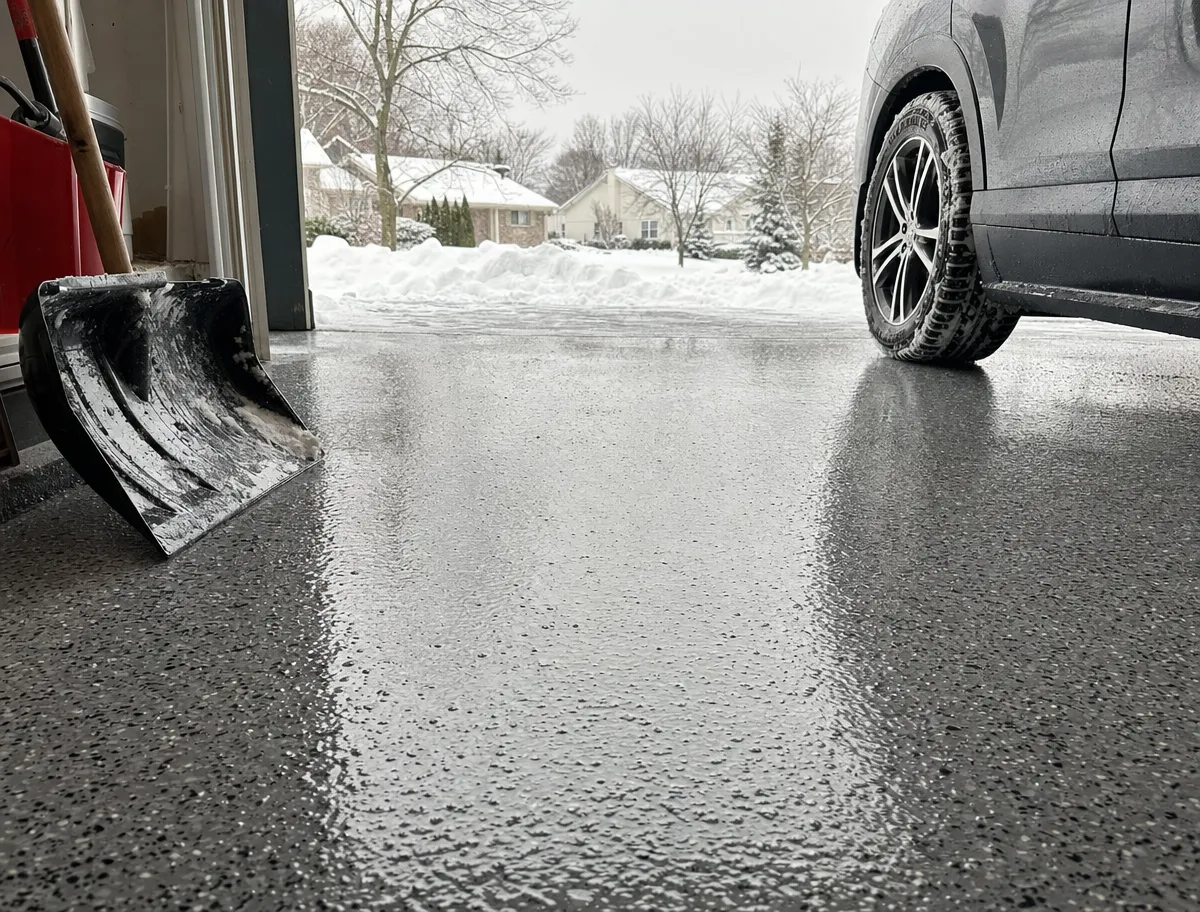
Quick Answer: Standard epoxy fails on Ohio auto shop floors because it cannot handle the combination of petroleum chemical attack, hot tire contact, and Ohio’s freeze-thaw concrete movement that auto shop environments produce every day. A professional polyaspartic system — or polyurea base coat with polyaspartic topcoat — provides genuine chemical resistance to motor oil, brake fluid, transmission fluid, and battery acid, handles hot tire contact without delaminating, and flexes through Ohio’s 30+ freeze-thaw cycles without cracking. It also cures same-day, so the shop returns to operation quickly.
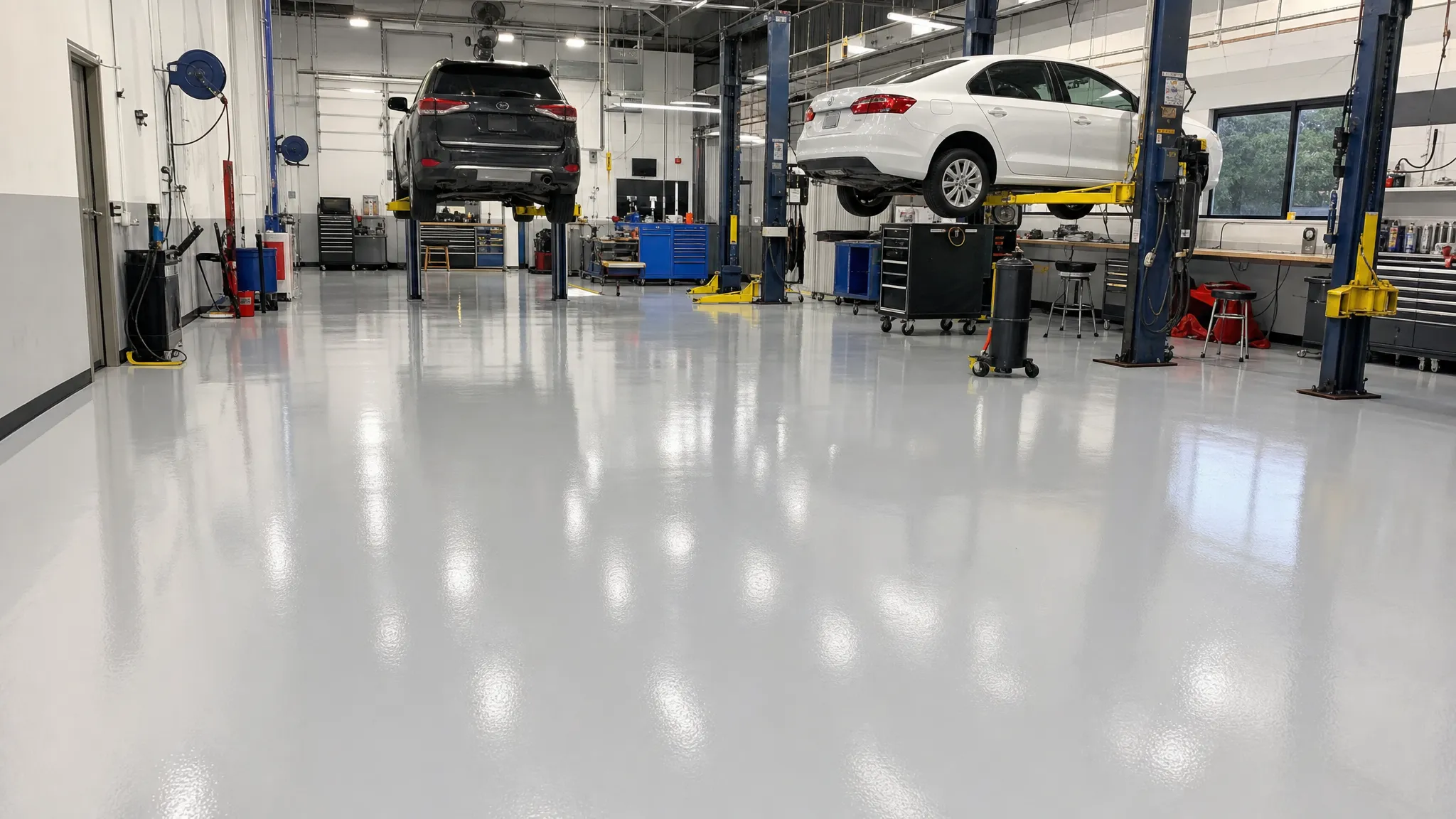
Ohio auto shop owners face a floor coating challenge that residential garage guides don’t cover: automotive floors don’t just see light foot traffic and an occasional oil drip. They see motor oil, transmission fluid, brake fluid, coolant, battery acid, and road salt every day — often simultaneously. They see hot tires from vehicles on lifts. They see floor jacks dragged across the surface and tool carts rolling constantly. And in Ohio, they see 30 or more freeze-thaw cycles per winter that stress every rigid coating bonded to the concrete slab below.
Standard epoxy — the coating most shop owners consider first because it’s the most familiar name in the category — is not built for these conditions. It’s built for controlled environments with moderate chemical exposure and stable temperatures. An Ohio auto shop is none of those things.
J&P Coatings installs professional-grade polyaspartic and polyurea/polyaspartic floor systems for Ohio auto shops — independent service centers, dealership service bays, specialty shops, and fleet maintenance facilities. This guide explains what actually fails about standard epoxy in an Ohio shop environment and what the right coating looks like.
Why Does Standard Epoxy Fail on Ohio Auto Shop Floors?
Three failure mechanisms combine in the auto shop environment:
Petroleum chemical attack
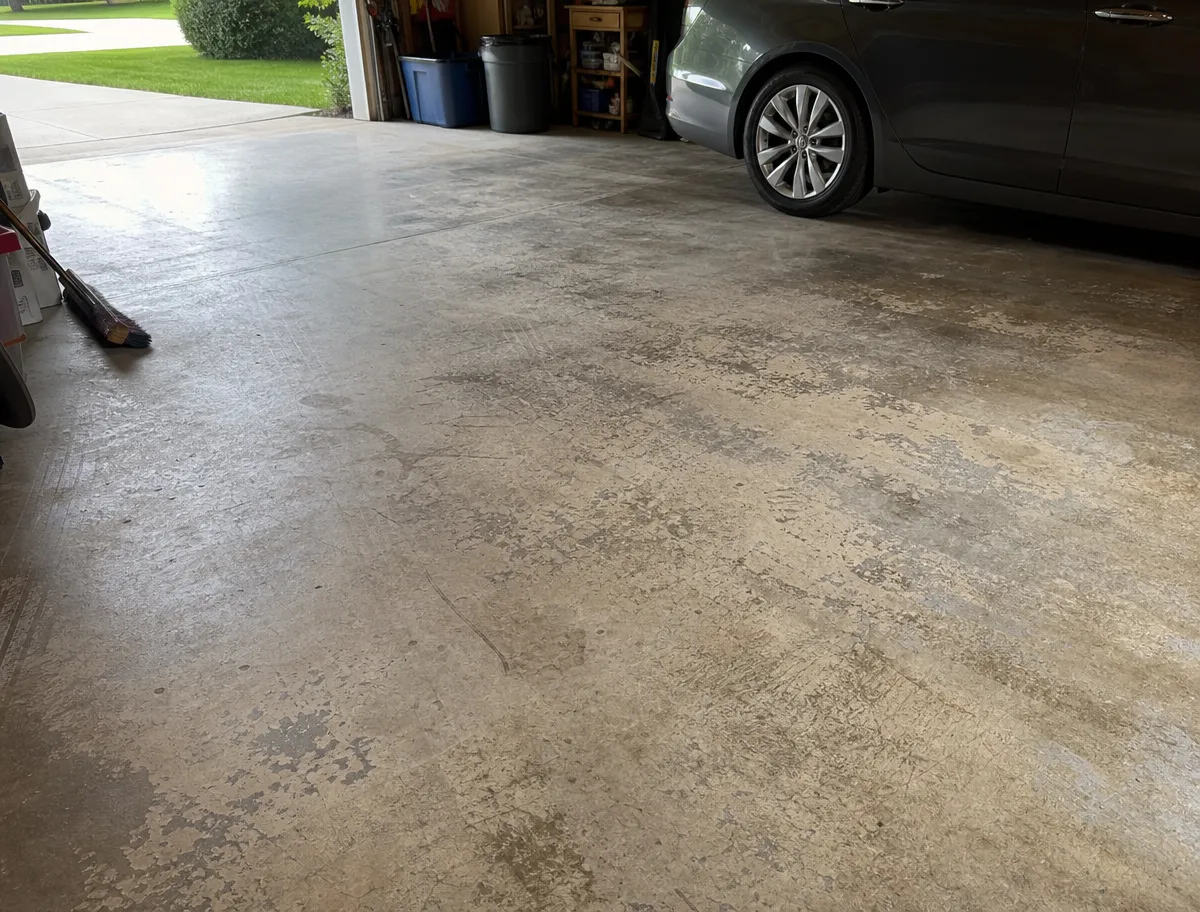
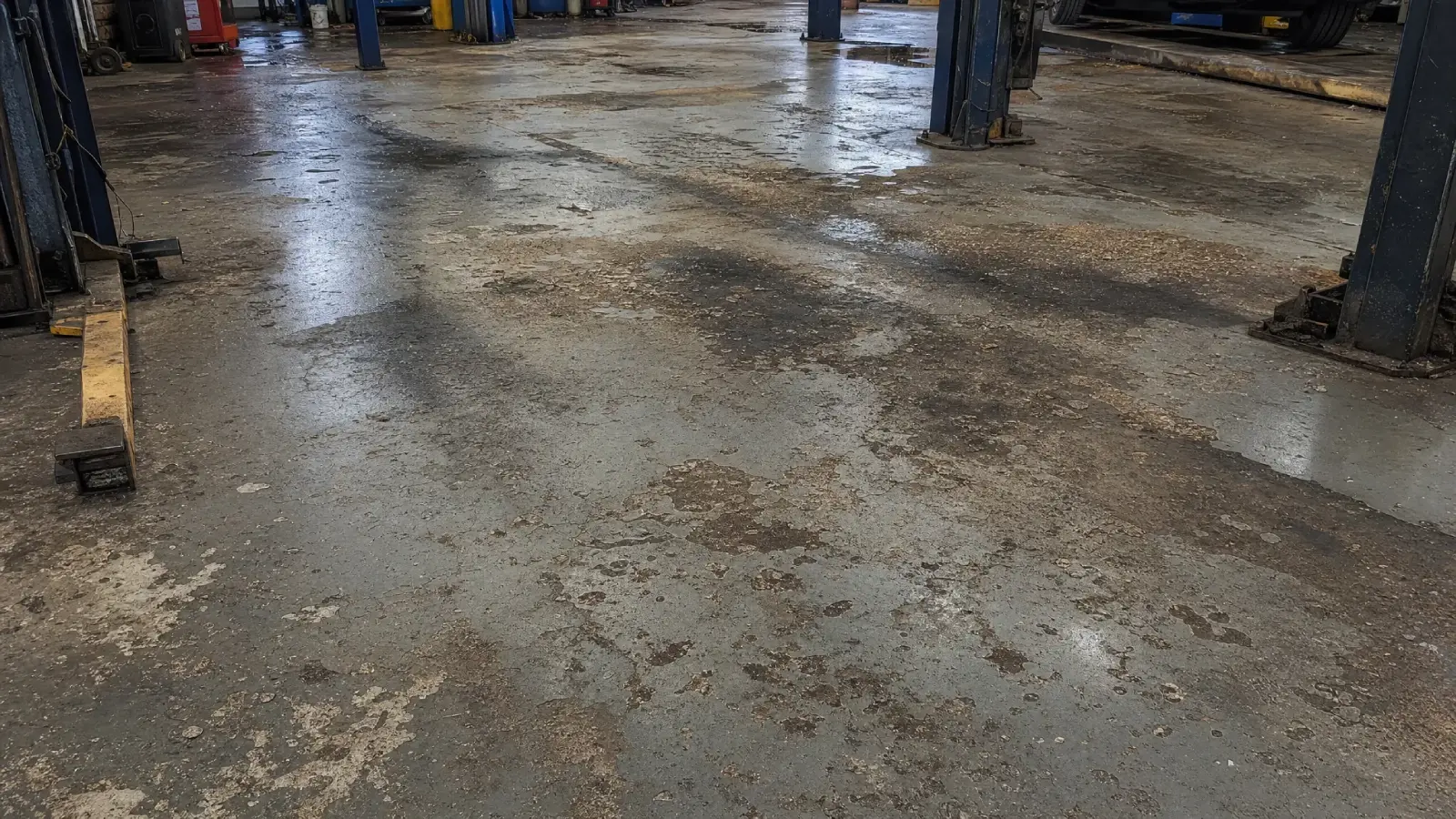
Motor oil, transmission fluid, brake fluid, coolant, and gasoline are petroleum-based or petroleum-derived chemical compounds. Standard epoxy’s binder chemistry reacts with prolonged petroleum exposure — the chemicals penetrate micro-pores in the coating surface, swell and soften the epoxy matrix, and accelerate delamination from below. A floor that looks fine after one year of service in an Ohio shop often shows visible oil-related degradation by year three: surface pitting, dark staining that won’t clean off, and areas where the coating has become soft and spongy under vehicle drip points.
Polyaspartic coatings are formulated with a more chemically resistant polymer matrix that does not react with petroleum compounds the same way. Oil spills on a properly installed polyaspartic floor can be cleaned off completely — they do not penetrate or degrade the surface.
Hot tire pickup and heat sensitivity
This is the failure mode that surprises most shop owners: hot tires cause epoxy floors to fail. When a vehicle comes off a lift after service, its tires are warm from driving and from the heat generated during service work. The warm rubber contacts the epoxy surface. Standard epoxy softens at elevated temperatures and adheres to warm rubber. When the vehicle drives away, the epoxy peels off with the tire — leaving ragged patches at every location where vehicles have been parked under lifts.
Polyaspartic coatings have a higher heat tolerance that prevents this thermal softening and hot tire pickup. In an Ohio shop that puts 10 to 30 vehicles through service daily, this alone justifies the premium over standard epoxy.
Ohio freeze-thaw slab movement
Ohio experiences 30 or more freeze-thaw cycles per winter in most markets. Each cycle causes the concrete slab to expand and contract. Standard epoxy is a rigid coating — it cannot flex with that movement. Stress accumulates at control joints, slab edges, and any point where the slab has an existing crack. Within 2 to 3 Ohio winters, most epoxy auto shop floors show cracking or delamination at these points, which then allows moisture and petroleum chemicals to infiltrate under the coating and accelerate failure everywhere the coating has begun to separate.
Surface prep is the variable most shop owners underestimate: Proper diamond grinding to CSP-2 or CSP-3 or opening the concrete pore profile and removing oil-contaminated surface concrete is mandatory for any coating system to bond properly to an auto shop floor. Shops that have operated for years on bare concrete have oil soaked into the top layer of the slab. No surface cleaner removes it. Diamond grinding does. Without it, no coating system will bond properly regardless of chemistry.
What Makes a Floor Coating Actually Oil-Resistant?
The claim “oil-resistant” on a coating product is not a standardized specification. What it means in practice depends on the coating chemistry:
- True chemical resistance means the coating’s polymer matrix does not react with, absorb, or degrade when in contact with petroleum compounds. This is a material chemistry property, not a surface treatment.
- Polyaspartic coatings have inherent chemical resistance to motor oil, brake fluid, transmission fluid, battery acid (sulfuric acid), coolants, and de-icing salts. These are the compounds an Ohio auto shop floor encounters daily.
- Standard epoxy varies widely in chemical resistance depending on formulation. Many commercial-grade epoxies offer decent short-term resistance but degrade with prolonged petroleum exposure. DIY and big-box epoxy kits are not formulated for commercial auto shop use.
- Easy cleanability is the practical outcome of chemical resistance: oil that sits on a polyaspartic surface can be wiped or mopped off completely without staining, because the oil has not penetrated the coating. Oil on a degraded epoxy surface penetrates and stains permanently.
What Is the Right Oil-Resistant Floor Coating for an Ohio Auto Shop?
The coating system J&P Coatings installs in Ohio auto shops is a multi-layer polyurea/polyaspartic build:
- Polyurea base coat: A fast-curing, high-adhesion base coat applied over diamond-ground concrete. The polyurea chemistry provides maximum adhesion, flexibility (handling Ohio’s freeze-thaw movement without cracking), and a moisture-vapor-resistant foundation.
- Decorative vinyl chip broadcast: Color-flake chips broadcast across the wet base coat provide texture, slip resistance, and the aesthetic that makes shop floors easier to maintain — dirt and oil are more visible against a chip-flake background than against solid dark concrete.
- Aliphatic polyaspartic topcoat: The UV-stable, chemically resistant topcoat that provides true oil resistance, hard-wearing abrasion resistance, and the easy-clean surface that keeps shop floors looking professional. Aliphatic polyaspartic does not yellow in UV — critical for bays with overhead doors open to sunlight during the day.
Key performance specifications for this system in Ohio auto shop use:
- Chemical resistance: Motor oil, brake fluid, transmission fluid, battery acid, coolant, gasoline, de-icing salts — all wiped clean without staining or surface degradation
- Heat tolerance: Handles hot tire contact without softening or delamination
- Freeze-thaw flexibility: Polyurea base flexes with Ohio’s slab movement rather than cracking
- UV stability: Aliphatic polyaspartic topcoat — no yellowing in direct sunlight
- Cure time: Same-day cure; vehicle traffic within 24 hours
- Abrasion resistance: Handles floor jack drag, rolling tool carts, and constant vehicle traffic without surface degradation
What Does the Installation Process Look Like for Ohio Auto Shops?
J&P Coatings works around shop schedules. Most Ohio auto shop floor coating installations are completed in one day. Here is the process:
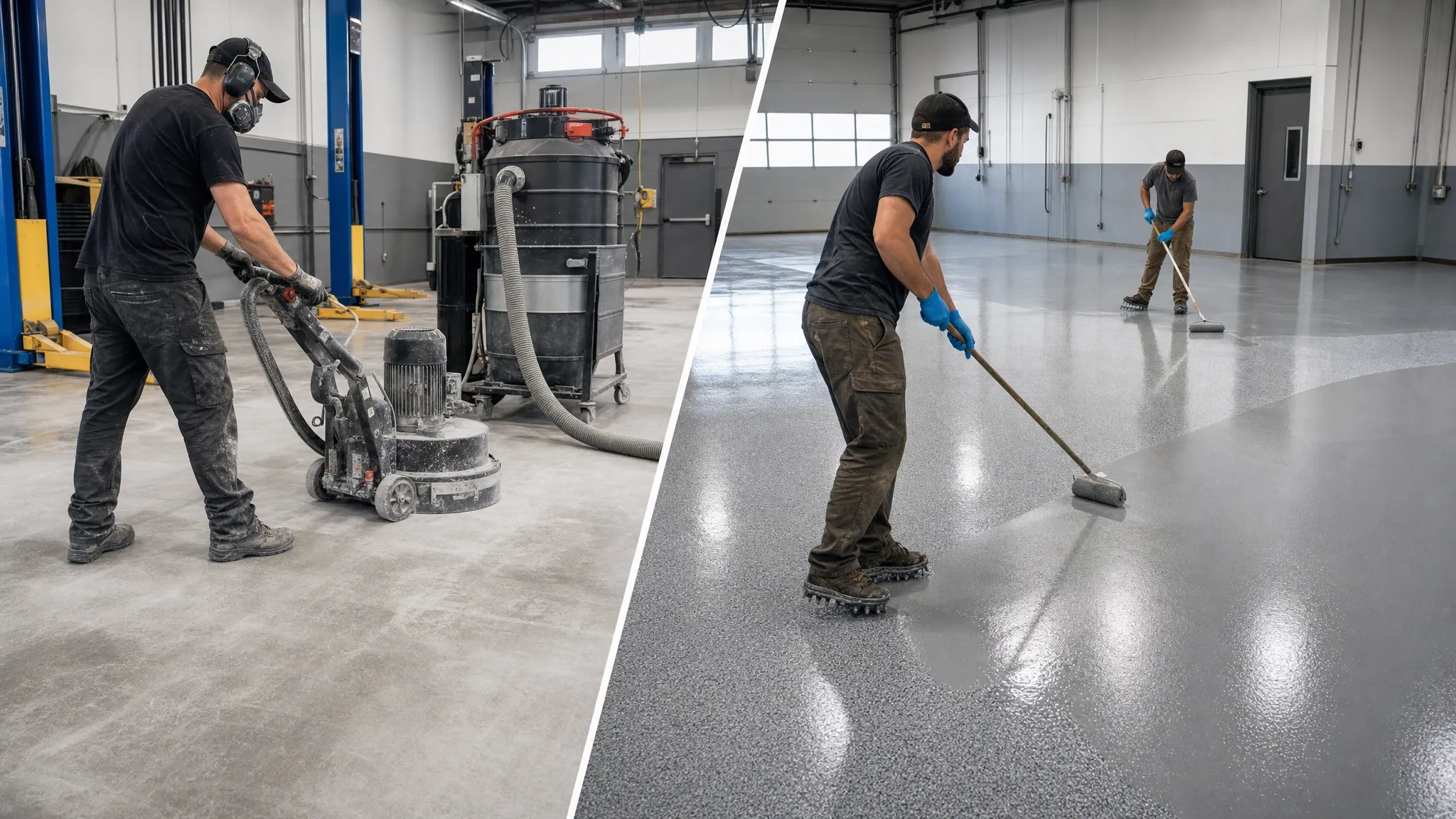
- Site evaluation: J&P evaluates the concrete, identifies oil contamination depth and extent, assesses existing cracks and spalling, and provides a written estimate with specific scope for prep and coating.
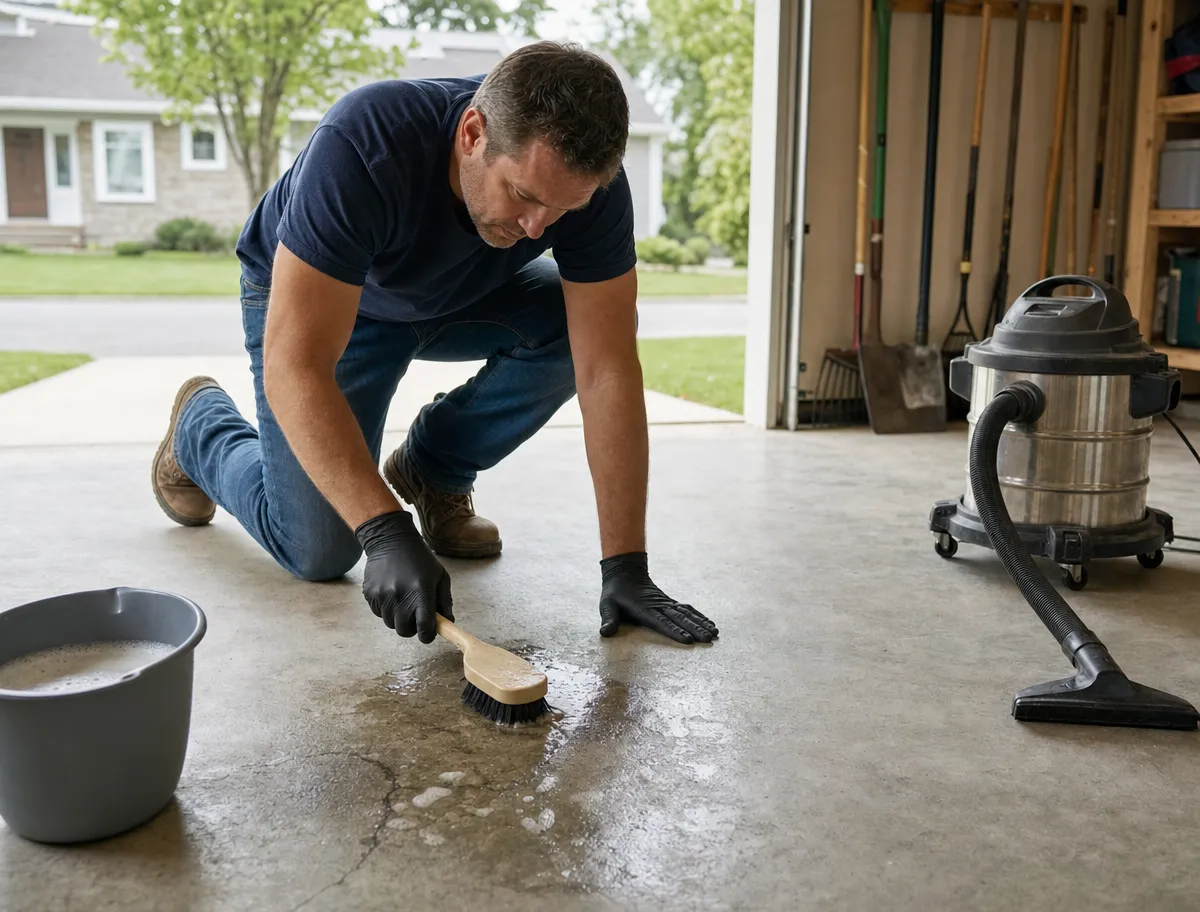
- Diamond grinding: Professional-grade diamond grinders open the concrete pore profile and remove oil-contaminated surface concrete. This step is not optional — it is what makes the coating bond. For shops with years of oil saturation in the slab, multiple grinding passes at different profiles may be needed.
- Oil contamination treatment: Any residual oil that diamond grinding reveals is treated with a commercial degreaser and heat application to draw out and neutralize penetrated oil before coating.
- Crack and spall repair: All cracks are filled with flexible polyurea crack filler. Spalled or pitted areas are leveled. These repairs are done before coating, not covered over by it.
- Polyurea base coat: Applied immediately after grinding dust is removed. Fast cure means the chip broadcast follows within minutes.
- Chip broadcast and topcoat: Decorative chips are broadcast, the floor is inspected, and the polyaspartic topcoat is applied for the final UV-stable, chemically resistant surface.
- For shops that need to remain operational, J&P can phase the project bay-by-bay — completing one section while keeping adjacent bays in service — to eliminate production downtime entirely.
TL;DR — Oil-Resistant Floor Coating for Ohio Auto Shops
- Standard epoxy fails Ohio auto shop floors — petroleum attack degrades the binder, hot tires peel it off lifts, and Ohio’s freeze-thaw cycles crack it at control joints.
- True oil-resistant floor coatings use polyaspartic chemistry — chemically inert to motor oil, brake fluid, battery acid, and de-icing salts.
- The right system for Ohio auto shops: polyurea base coat (adhesion + flexibility) + decorative chip broadcast + aliphatic polyaspartic topcoat (oil resistance + UV stability).
- Diamond grinding is mandatory — oil-soaked auto shop concrete cannot be coated without removing the contaminated surface layer.
- Cost: $4–8/sq ft installed in Ohio. Most auto shop installations complete in one day with same-day walk-on; vehicle traffic in 24 hours.
- Contact J&P Coatings for a free Ohio auto shop floor coating estimate.
Frequently Asked Questions
What is the best oil-resistant floor coating for an Ohio auto shop?
A professional polyaspartic system — either polyaspartic alone or over a polyurea base coat — is the best oil-resistant floor coating for most Ohio auto shops. Polyaspartic is chemically resistant to motor oil, brake fluid, transmission fluid, battery acid, and de-icing salts. It is UV-stable, flexible through Ohio’s freeze-thaw cycles, and cures same-day. J&P Coatings installs the full system — polyurea base, decorative chip broadcast, and aliphatic polyaspartic topcoat — for Ohio auto service facilities.
Why does standard epoxy fail on auto shop floors in Ohio?
Standard epoxy fails for three reasons in Ohio auto shops: petroleum chemicals (motor oil, brake fluid) degrade the epoxy binder over time; hot tire contact causes the epoxy to soften and peel off with warm tires leaving the lift; and Ohio’s 30+ freeze-thaw cycles per winter crack and delaminate rigid epoxy at control joints and slab edges. Most Ohio auto shop epoxy installs show significant degradation within 3 to 7 years.
Does oil contamination in the concrete prevent floor coating adhesion?
Yes — oil contamination is the leading cause of coating failure in auto shops. Oil that has soaked into the slab cannot be removed by surface cleaning. Professional diamond grinding removes the contaminated surface concrete, exposing a clean, porous substrate that the coating can bond to. Coating over an oil-contaminated slab — without diamond grinding — produces coating failure within months: peeling in circles (fisheyes) at invisible oil residue points.
How much does auto shop floor coating cost in Ohio?
Professional polyaspartic auto shop floor coating in Ohio typically runs $4 to $8 per square foot installed. A standard two-bay shop of 800 to 1,200 square feet runs approximately $3,200 to $9,600. Shops with severe oil contamination or significant concrete damage will be at the higher end. J&P Coatings provides free on-site estimates for Ohio auto shops with written quotes before any work begins.
How long does auto shop floor coating installation take in Ohio?
J&P Coatings completes most Ohio auto shop floor coating installations in one day, including diamond grinding, crack and spall repair, base coat, chip broadcast, and polyaspartic topcoat. Walk-on time is same-day; vehicle traffic returns within 24 hours. For shops that need to remain operational, J&P phases installation bay-by-bay to keep the shop in service throughout the project.
Related Guides
- J&P Coatings – Auto Shop Floor Coating in Ohio
- Commercial Floor Coating Ohio
- Garage Floor Coating Ohio
- Best Floor Coating for an Auto Repair Shop
Ready to Protect Your Ohio Auto Shop Floor? Get a Free Estimate
J&P Coatings installs oil-resistant polyaspartic floor coating systems for auto shops, dealership service bays, and fleet maintenance facilities throughout Ohio. Every estimate includes a free on-site evaluation, diamond grinding assessment, and written quote — with phased installation available so your shop never has to shut down. Get a free estimate today.
About J&P Coatings | J&P Coatings is an Ohio concrete floor coating contractor specializing in polyurea and polyaspartic floor systems for auto shops, commercial facilities, and residential garages throughout Ohio. Services include diamond grinding surface preparation, oil contamination remediation, and professional-grade coating installation. Free on-site estimates for all Ohio auto shop and commercial projects.